
Pleasant Games
‘I like feminine girls. I’m glad my daughter doesn’t play football anyway. It’s not natural', said a spokesman for the Football Association when I asked for the FA's policy on girls playing footie.

That was in 1978. The FA had managed to all but destroy women’s and girls’ football, even in mixed games.
Women had in fact been playing organised football from the 1880s and it had proved spectacularly popular. On Boxing Day 1920, 53,000 supporters filled Goodison Park in Liverpool to capacity, with thousands more outside. The women’s teams, made up largely of factory girls, raised large sums for charity - as much as £3,000 for that Boxing Day match.
Why then did the Football Association take the extraordinary decision, just a few months later, to ban women and girls from the game? How was it they felt they had the right to make such a momentous decision? This is what they said at the time:
“Complaints having been made as to football being played by women, Council felt impelled to express the strong opinion that the game of football is quite unsuitable for females and should not be encouraged. Complaints have also been made as to the conditions under which some of the matches have been arranged and played, and the appropriation of receipts to other than charitable objects. The Council are further of the opinion that an excessive proportion of the receipts are absorbed in expenses and an inadequate percentage devoted to charitable objects.
“For these reasons the Council requests the Clubs belonging to the Association refuse the use of their grounds for such matches.”
The aspersions cast on the financial dealings of the women’s teams was stinging and outrageous at the time but now, with the advantage of history, it makes you want to weep with a mixture of pain, sorrow and hilarity. And throw up.
For over fifty years during the twentieth century women and girls were kept out of football. The Football Association had seen to it that women could not organise their own teams and play, even though they had previously been playing internationally as well as nationally.
Other countries too banned women from playing football. This was, of course, for the women’s own good: it wasn’t ‘aesthetic’ for women to play it and they would suffer from playing a game that was ‘fundamentally foreign to the nature of women.’
The men of the Football Association were deeply concerned for the children of women who played football. In fact, there wouldn’t be any such children, their potential mothers having made themselves infertile by playing ‘unnatural’ sports.
Women and girls were banned from playing football in numerous countries while in some places, notably the Middle East, they were not even allowed to watch it.
‘In the fight for the ball, the feminine grace vanishes, body and soul will inevitably suffer harm’, etc, etc, repeated the men who were in total control of the game and making crucial decisions that would affect women and girls for years to come.
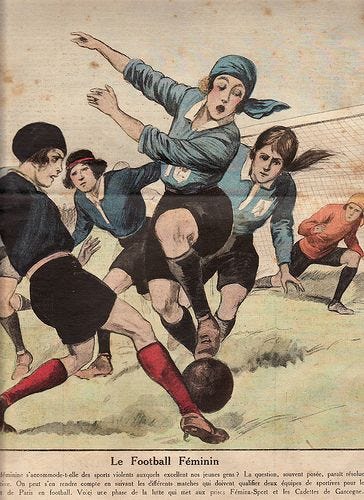
Fast forward to 1978. The Equal Opportunities Act and the Sex Discrimination Acts had just been passed and, with renewed energy and hope, women and girls were branching out and taking on challenges.
Theresa Bennett was, with her mother, taking the Football Association to court challenging its ban on girls playing the beautiful game.
I published an article in the Times Educational Supplement in February 1978.
I have written it out here. It is worth reading if only for the classic pompous quotes from the FA.
Theresa Bennett, 11 year old schoolgirl of Little Carlton, Newark, is to challenge the Football Association’s ban on mixed matches for under-12s. Penny Allen fills in the background.
Schoolgirl takes on football’s top brass
Girls can be seen in many schools kicking a ball around with the boys at lunch time, but these ad hoc teams will not tolerate ineptitude. So a girl who is not allowed to play in the school team or to attend class football lessons has to be exceptionally good to keep up with the game.
As one girl put it, ‘If a girl lets in a goal they think you’re no good. If a boy does, nobody says anything.’
There may be schools where girls take class football, although three games teachers in South London said staffing problems made it impossible. The girls, often begrudgingly, did needlework one afternoon a week while the boys went off to Clapham Common.
The English Schoolboys Football Association, however, which is recognised by the Sports Council, the Football Association and the Football League as its governing body for schools football, has never in all its 75 years permitted a girl to participate. ‘God forbid,’ said Glyn Evans, its secretary, ‘that we ever did.’
For this crime, the most severe in the book, the Football Association can order the match to be replayed or award the guilty team’s points to the other side.
The English Schools Football Association abides by the rules of the FA. I asked the FA’s secretary, Mr Ted Croker, the reason for the ban on mixed games. ‘We just don’t like males and females playing football together,’ he said. ‘I like feminine girls. I’m glad my daughter doesn’t play football anyway. It’s not natural.
‘It must be remembered that it is a very very hard physical game. I don’t want to see it become like boxing where they’re softening it up. And there’s the problem of changing rooms. I wouldn’t mind, I’d be delighted to change with a woman. I don’t really think it’s good though, not even for young boys and girls.
‘There are plenty of other pleasant games. And there’s nothing to stop a group of girls getting together and setting up their own team.’
There is a Women’s Football Association, but while the Schools’ Association allows an age difference of only two years in any match, the 250 women’s teams consist of women and girls of all ages. To protect the young girls they have a lower age limit of 13 (though they do take girls of 11 for training). They have sent out a questionnaire to 2,000 schools in southern England to discover the number of girls’ teams and the amount of interest.
The secretary, Miss Pat Gregory, thinks that until age 11 or 12 girls and boys should play together, but after that they should have separate teams. ‘In my experience,’ she says, ‘there are always one or two men who just are not going to be beaten by girls. Girls could be done irreparable harm.’
So, short of 11-year old girls rising up and forming their own national football league, there seems no likelihood of their officially playing team football. But through their own ingenuity and with the help of sympathetic games masters they are finding ways round the rules.
One girl, described by her coach as ‘the best left-winger in Battersea’, tucked her plaits inside her woolly hat and played in her local team for months before anyone discovered her sex. She still plays.
Another football teacher describes the three girls in his squad as ‘some of my best players’. He plays one of them each week in the school team, warning the teacher of the opposing team in advance, and has never met with any objection. In his league division there are 12 teams, three of which play girls.
In contrast to Mr Croker’s wish to keep the game tough, the teachers I spoke to say they always modify boys’ football to make it less violent, and to emphasise technical skill and grace.
Teachers and girls being forced into subversive behaviour because of their love of the game can obviously not continue indefinitely. Parents who have asked for a more lenient attitude have been told by Mr Croker: ‘I’m not worried about the parents of the girls. It’s what the parents of the boys might think that bothers me.’
Theresa Bennett’s mother, however, is getting assistance from the Equal Opportunities Commission to take the Football Association to court under the Sex Discrimination Act. Theresa plays in the local team and was vetted by Nottinghamshire to play for the county. The Association, on discovering this, refused her permission to play.
The court’s decision is likely to pivot on Section 44 of the Act, which gives specific exemption in sport ‘where the physical strength stamina or physique of the average woman puts her at a disadvantage to the average man.’
This clause, in generalising about women at the expense of the individual, could clear the Football Association and give weight to Mr Croker’s preconceptions of what is and is not ‘natural’ or ‘feminine’. Obviously, when restrictions are lifted and women are able to extend their experience, what is considered average changes.
The Act, if it seriously hopes to improve the status of women, should encourage them to enter previously forbidden fields, and to decide for themselves what is feminine. Not so long ago it was thought not only unnatural but highly undesirable for the average female to have a strenuous education.
*
When I wrote that article in 1978 I had no idea that there ever had been such a thing as women’s football and women’s teams. It had all been erased from history and we had gone along with the notion that women didn’t play football because they chose not to.
It wasn’t until I wrote a piece for Substack a couple of years ago that I found the excellent research which showed how vibrant and how popular the women’s game had been before the FA set about destroying it.
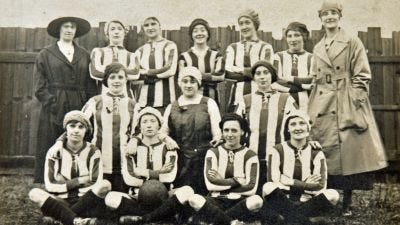
The extremely popular and successful Dick, Kerr team
The Dick, Kerr Ladies, was located in Lancashire and peopled by factory girls - the name comes from the factory. Playing a total of 828 matches, the Dick, Kerr’s Ladies only lost 24 games and drew 46.The Ladies played teams from all over England and even in France, and they attracted massive crowds that sold out stadiums and helped take care of British war veterans. - so writes Wikipedia and adds,
One player for Dick, Kerr’s was Lily Parr, who is the only female footballer in the National Football Museum Hall of Fame. Standing at almost six feet tall, she was known for her powerful kick that was said to be just as strong as a man’s. In the years she played football, she scored over 900 goals, making her one of football’s most prolific goal-scorers.
When the Football Association banned women’s football in 1921, the first female MP had just taken her seat (in 1919) and in the US women had just been granted the vote.
Having banned women from football and thereby from earning a living from it, the FA continued to oppose and obstruct them. When finally, through the Equal Opportunities legislation, women got the right to at least play, the women’s network had been decimated and, seventy years after they had last played, they had to try to pick up the pieces.
By this time men were making stupendous sums from football (and not dedicating it to charity) but even today, what a female player might expect to get is less than the minimum wage (and a great deal less than a footballer’s wife might spend on a litigious spat with her friend.)
The immensely popular women’s football teams of the past had given all their earnings to charity and part of the reason that men objected so strongly was that the charities they chose were not exclusively for the war-wounded but for women and children too. The aspersions made on women footballers included the lie that they had benefitted financially from the game.
The Football Association now has the chance to make up for its historical mistakes and hand over some of its vast wealth to the women’s teams that helped it on its way.
For more on this, see Simon Kuper: ‘Women’s Football, the Case for Reparations’ in the Financial Times July 29th 2022.
*
Here is my article from the TES:
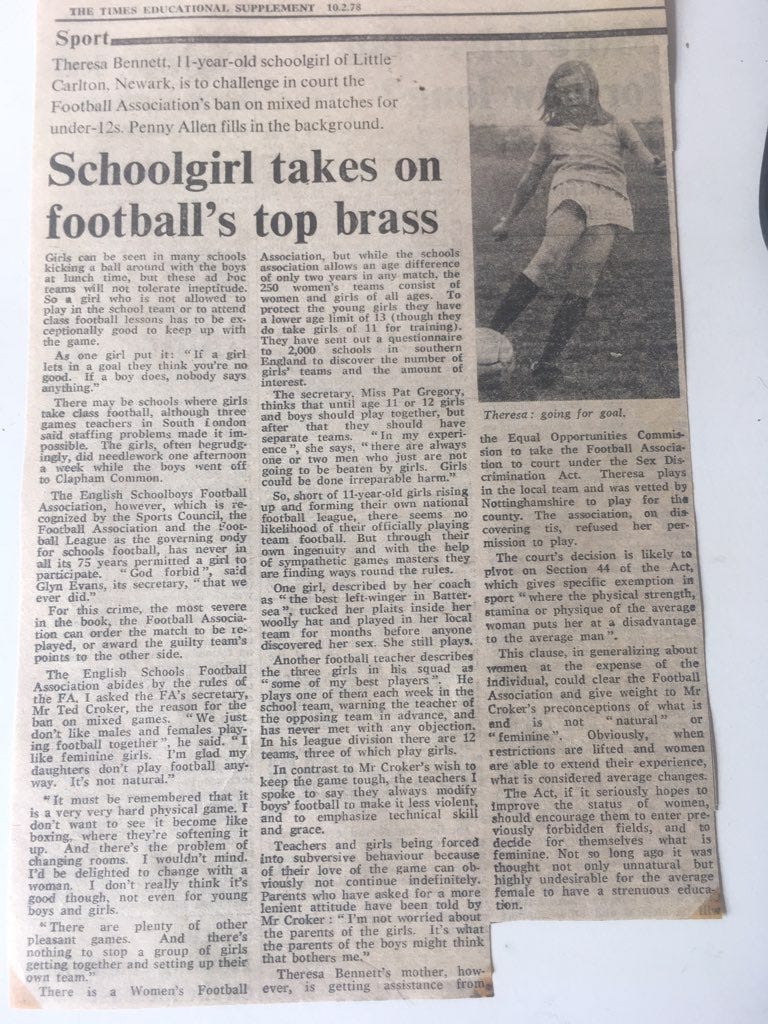
I republished this article on Substack in December 2022 and had this response from my niece, Cathy, who at that time in the late 70s had been a superb footballer.
‘Oh my’, she wrote, ‘it takes me back - a joy! The joy of playing every day in the playground and being among the first picks when the captains picked the teams; the sadness of being prevented to go further’.
Cathy played in a team for a year or two while she was still at a mixed junior school. But, once she moved to an all girls senior school, she no longer had any opportunity to play.
I don't know whether it was your 1978 article (it could easily have been), or another at around that time that added a foundation stone to my near fifty year support for women's equality. Croker's comments, even to a working-class youth with no interest in football, were astoundingly awful, lacking any sense.
In the 60’s and 70’s I campaigned for equal rights for women. We wanted women not to be excluded from the stadiums, and for women to have access to their own toilet facilities. It was my Edwardian mother who told me women’s football was extremely popular in her youth. I had no idea women even played it.
My grandmother would take all the children on a Saturday afternoon, including the baby, for a picnic on the grassy bank at the side of the pitch. The atmosphere was nothing like it was in the men’s football, notorious for heavy fouling, swearing and spitting. The “factory girls” relied on skill. All teams gave donations to the local hospital.
Gradually, the popularity of the women’s football began to encroach on the attendance and profit of the men’s matches. It was then the FA stepped in and banned football for women.
Odd how then, female decency and lack of facilities for women were part of the excuses for denying women sport, and 100 years later women are expected to allow men into their sport, changing room and baths, pretending they don’t mind because they don’t know a man when they see one.